Schön voll in der AG. 10 SuS. Forschungs-AG und PC-AG gemixt.
Karl zeigt mir https://developer.meta.com/ai/models/muse-spark/
Und opencode https://opencode.ai/de
Nächste Mal ist Schulfest. Da findet die AG nicht statt.
Schön voll in der AG. 10 SuS. Forschungs-AG und PC-AG gemixt.
Karl zeigt mir https://developer.meta.com/ai/models/muse-spark/
Und opencode https://opencode.ai/de
Nächste Mal ist Schulfest. Da findet die AG nicht statt.
Draußen über 30 Grad. Mit Linux-Stick wird Linux auf einem Laptop installiert. Nächste Mal gibts Bundesjugendspiele. Dann sind Ferien.
Ein Korg sv1 vintage stage hat en Weg in die AG gefunden. Ein XLR-Ausgang ist vermutlich defekt. Öffnung des Gerätes nicht so einfach. Gerät geht erst Mal wieder zurück.
Wir versuchen uns an einem Arduino-Board. Klappt nicht, weil der Treiber nicht installliert ist und nur vom Admin installiert werden kann.
Nächste und übernächste Woche fällt aus, weil Brückentag. Danach ist Abitur.
In drei Wochen normal.
Morten ist da und 3 SuS. Ich traf Frau Spyra.
Wir reden auch über Proxys, Ports und Windows7-Bitflips.
Nächste Mal normal.
Test.
Erste Mal nach den Osterferien. Sonne scheint. Angelo wollte noch kommen. Jemand versucht Archlinux vom Stick zu installieren. Oder Ubuntu. Aber vom Ubuntustick bootet es nicht. Angelo ist hier zu sehen:
Geht auch um Arpanet – https://de.wikipedia.org/wiki/ARPANET.
Ubuntu auf dem Stick hat mit dd geklappt, die Version vorher ging nicht. War auch von Ubuntu aus installiert.
Geht auch um https://de.wikipedia.org/wiki/FVWM.
Nächste Mal normal.
Heute ist eine weitere Person der SuS dazu gekommen. Die Forscher:innen-AG hat offenbar auch Zuwachs bekommen. Wir haben ein Auto-Loop-Batch-Script angeschaut.
Notizen: https://fobizz.com/de/
Nächste Mal normal.
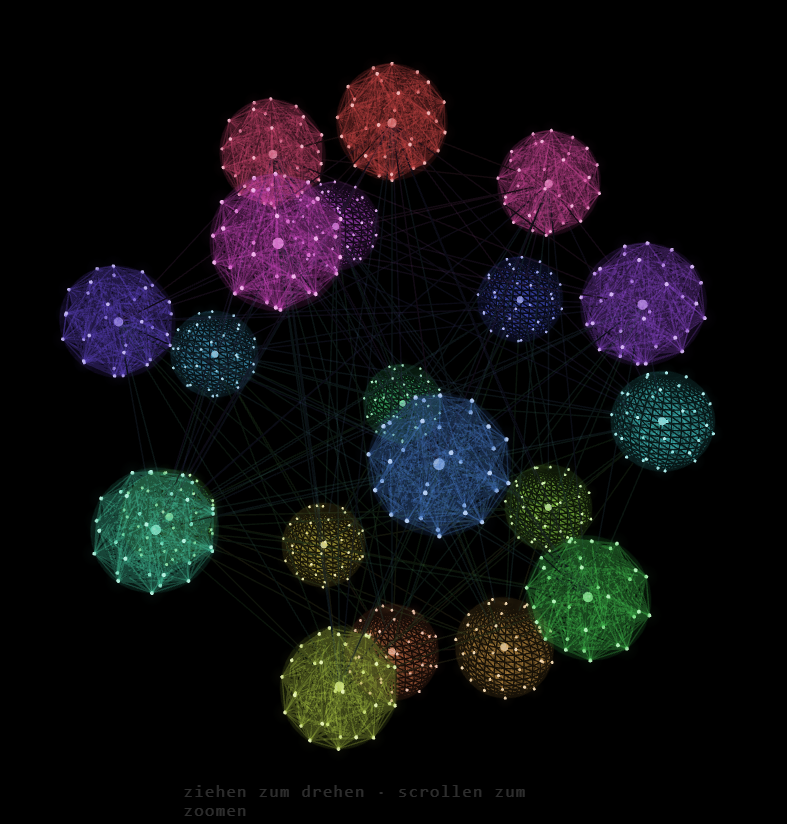
Claude – Kugeln.
<!DOCTYPE html>
<html lang="de">
<head>
<meta charset="UTF-8">
<meta name="viewport" content="width=device-width, initial-scale=1.0">
<title>12 × K₁₂ — 3D</title>
<style>
  * { margin: 0; padding: 0; box-sizing: border-box; }
  body { background: #000; overflow: hidden; }
  canvas { display: block; }
  #hint {
    position: fixed;
    bottom: 16px;
    left: 50%;
    transform: translateX(-50%);
    color: rgba(255,255,255,0.2);
    font: 12px monospace;
    letter-spacing: 0.1em;
    pointer-events: none;
    transition: opacity 2s;
  }
</style>
</head>
<body>
<div id="hint">ziehen zum drehen · scrollen zum zoomen</div>
<script src="https://cdnjs.cloudflare.com/ajax/libs/three.js/r128/three.min.js"></script>
<script>
(() => {
  // === Config ===
  const NC = 12;
  const NP = 12;
  const BIG_R = 5.0;
  const SMALL_R = 1.1;

  // === Setup ===
  const scene = new THREE.Scene();
  const camera = new THREE.PerspectiveCamera(55, window.innerWidth / window.innerHeight, 0.1, 100);
  camera.position.set(0, 6, 14);
  camera.lookAt(0, 0, 0);

  const renderer = new THREE.WebGLRenderer({ antialias: true, alpha: false });
  renderer.setSize(window.innerWidth, window.innerHeight);
  renderer.setPixelRatio(window.devicePixelRatio);
  renderer.setClearColor(0x000000);
  document.body.appendChild(renderer.domElement);

  // === Distribute NC points on sphere (Fibonacci) ===
  function fibSphere(n, radius) {
    const pts = [];
    const goldenAngle = Math.PI * (3 - Math.sqrt(5));
    for (let i = 0; i < n; i++) {
      const y = 1 - (i / (n - 1)) * 2;
      const r = Math.sqrt(1 - y * y);
      const theta = goldenAngle * i;
      pts.push(new THREE.Vector3(
        r * Math.cos(theta) * radius,
        y * radius,
        r * Math.sin(theta) * radius
      ));
    }
    return pts;
  }

  // Cluster centers on big sphere
  const centers = fibSphere(NC, BIG_R);

  // Hues
  const hues = [];
  for (let i = 0; i < NC; i++) hues.push((i * 30) % 360);

  function hslToRGB(h, s, l) {
    s /= 100; l /= 100;
    const k = n => (n + h / 30) % 12;
    const a = s * Math.min(l, 1 - l);
    const f = n => l - a * Math.max(-1, Math.min(k(n) - 3, 9 - k(n), 1));
    return new THREE.Color(f(0), f(4), f(8));
  }

  // === Build geometry ===
  const clusters = [];

  for (let ci = 0; ci < NC; ci++) {
    const center = centers[ci];
    const h = hues[ci];

    // Local points on small sphere around center
    const localPts = fibSphere(NP, SMALL_R);
    const worldPts = localPts.map(p => p.clone().add(center));

    clusters.push({ center, points: worldPts, hue: h });
  }

  // === Create line materials & geometries ===
  const macroGroup = new THREE.Group();
  const intraGroup = new THREE.Group();
  const dotsGroup = new THREE.Group();

  // --- Macro lines (cluster center to center) ---
  for (let i = 0; i < NC; i++) {
    for (let j = i + 1; j < NC; j++) {
      const mixH = (hues[i] + hues[j]) / 2;
      const color = hslToRGB(mixH, 45, 55);

      const geom = new THREE.BufferGeometry().setFromPoints([
        clusters[i].center, clusters[j].center
      ]);
      const mat = new THREE.LineBasicMaterial({
        color: color,
        transparent: true,
        opacity: 0.2,
        linewidth: 1
      });
      macroGroup.add(new THREE.Line(geom, mat));
    }
  }

  // --- Intra-cluster lines ---
  for (let ci = 0; ci < NC; ci++) {
    const pts = clusters[ci].points;
    const color = hslToRGB(hues[ci], 65, 60);

    // Batch all intra lines into one geometry for performance
    const positions = [];
    for (let i = 0; i < NP; i++) {
      for (let j = i + 1; j < NP; j++) {
        positions.push(pts[i].x, pts[i].y, pts[i].z);
        positions.push(pts[j].x, pts[j].y, pts[j].z);
      }
    }
    const geom = new THREE.BufferGeometry();
    geom.setAttribute('position', new THREE.Float32BufferAttribute(positions, 3));
    const mat = new THREE.LineBasicMaterial({
      color: color,
      transparent: true,
      opacity: 0.45
    });
    intraGroup.add(new THREE.LineSegments(geom, mat));
  }

  // --- Dots as small spheres ---
  // Center dots (bigger)
  for (let ci = 0; ci < NC; ci++) {
    const color = hslToRGB(hues[ci], 60, 80);
    const geo = new THREE.SphereGeometry(0.1, 12, 12);
    const mat = new THREE.MeshBasicMaterial({ color });
    const mesh = new THREE.Mesh(geo, mat);
    mesh.position.copy(clusters[ci].center);
    dotsGroup.add(mesh);
  }

  // Small point dots
  for (let ci = 0; ci < NC; ci++) {
    const color = hslToRGB(hues[ci], 70, 85);
    const geo = new THREE.SphereGeometry(0.05, 8, 8);
    const mat = new THREE.MeshBasicMaterial({ color });

    for (let i = 0; i < NP; i++) {
      const mesh = new THREE.Mesh(geo, mat);
      mesh.position.copy(clusters[ci].points[i]);
      dotsGroup.add(mesh);
    }
  }

  // --- Glow sprites for cluster centers ---
  const glowCanvas = document.createElement('canvas');
  glowCanvas.width = 64;
  glowCanvas.height = 64;
  const gctx = glowCanvas.getContext('2d');
  const grad = gctx.createRadialGradient(32, 32, 0, 32, 32, 32);
  grad.addColorStop(0, 'rgba(255,255,255,0.6)');
  grad.addColorStop(0.3, 'rgba(255,255,255,0.15)');
  grad.addColorStop(1, 'rgba(255,255,255,0)');
  gctx.fillStyle = grad;
  gctx.fillRect(0, 0, 64, 64);
  const glowTex = new THREE.CanvasTexture(glowCanvas);

  for (let ci = 0; ci < NC; ci++) {
    const color = hslToRGB(hues[ci], 70, 65);
    const spriteMat = new THREE.SpriteMaterial({
      map: glowTex,
      color: color,
      transparent: true,
      opacity: 0.4,
      blending: THREE.AdditiveBlending,
      depthWrite: false
    });
    const sprite = new THREE.Sprite(spriteMat);
    sprite.position.copy(clusters[ci].center);
    sprite.scale.set(1.8, 1.8, 1);
    dotsGroup.add(sprite);
  }

  scene.add(macroGroup);
  scene.add(intraGroup);
  scene.add(dotsGroup);

  // === Simple orbit controls (no import needed) ===
  let isDragging = false;
  let prevMouse = { x: 0, y: 0 };
  let rotY = 0, rotX = 0.3;
  let targetRotY = 0, targetRotX = 0.3;
  let autoRotate = true;
  let dist = 14, targetDist = 14;

  renderer.domElement.addEventListener('mousedown', e => {
    isDragging = true;
    prevMouse = { x: e.clientX, y: e.clientY };
    autoRotate = false;
    document.getElementById('hint').style.opacity = '0';
  });
  renderer.domElement.addEventListener('mousemove', e => {
    if (!isDragging) return;
    const dx = e.clientX - prevMouse.x;
    const dy = e.clientY - prevMouse.y;
    targetRotY += dx * 0.005;
    targetRotX += dy * 0.005;
    targetRotX = Math.max(-Math.PI / 2, Math.min(Math.PI / 2, targetRotX));
    prevMouse = { x: e.clientX, y: e.clientY };
  });
  renderer.domElement.addEventListener('mouseup', () => isDragging = false);
  renderer.domElement.addEventListener('mouseleave', () => isDragging = false);

  // Touch
  renderer.domElement.addEventListener('touchstart', e => {
    isDragging = true;
    prevMouse = { x: e.touches[0].clientX, y: e.touches[0].clientY };
    autoRotate = false;
    document.getElementById('hint').style.opacity = '0';
  });
  renderer.domElement.addEventListener('touchmove', e => {
    if (!isDragging) return;
    e.preventDefault();
    const dx = e.touches[0].clientX - prevMouse.x;
    const dy = e.touches[0].clientY - prevMouse.y;
    targetRotY += dx * 0.005;
    targetRotX += dy * 0.005;
    targetRotX = Math.max(-Math.PI / 2, Math.min(Math.PI / 2, targetRotX));
    prevMouse = { x: e.touches[0].clientX, y: e.touches[0].clientY };
  }, { passive: false });
  renderer.domElement.addEventListener('touchend', () => isDragging = false);

  // Zoom
  renderer.domElement.addEventListener('wheel', e => {
    targetDist += e.deltaY * 0.01;
    targetDist = Math.max(5, Math.min(30, targetDist));
    document.getElementById('hint').style.opacity = '0';
  });

  // === Animate ===
  function animate() {
    requestAnimationFrame(animate);

    if (autoRotate) targetRotY += 0.003;

    // Smooth interpolation
    rotY += (targetRotY - rotY) * 0.08;
    rotX += (targetRotX - rotX) * 0.08;
    dist += (targetDist - dist) * 0.08;

    camera.position.set(
      dist * Math.cos(rotX) * Math.sin(rotY),
      dist * Math.sin(rotX),
      dist * Math.cos(rotX) * Math.cos(rotY)
    );
    camera.lookAt(0, 0, 0);

    renderer.render(scene, camera);
  }

  animate();

  // Resize
  window.addEventListener('resize', () => {
    camera.aspect = window.innerWidth / window.innerHeight;
    camera.updateProjectionMatrix();
    renderer.setSize(window.innerWidth, window.innerHeight);
  });
})();
</script>
</body>
</html>
Rotierende Kugeln:
<!DOCTYPE html>
<html lang="de">
<head>
<meta charset="UTF-8">
<meta name="viewport" content="width=device-width, initial-scale=1.0">
<title>32 × K₃₂ — Kreisel</title>
<style>
  * { margin: 0; padding: 0; box-sizing: border-box; }
  body { background: #000; overflow: hidden; }
  canvas { display: block; }
  #hint {
    position: fixed; bottom: 16px; left: 50%; transform: translateX(-50%);
    color: rgba(255,255,255,0.18); font: 11px monospace;
    letter-spacing: 0.1em; pointer-events: none; transition: opacity 3s;
  }
</style>
</head>
<body>
<div id="hint">ziehen zum drehen · scrollen zum zoomen</div>
<script src="https://cdnjs.cloudflare.com/ajax/libs/three.js/r128/three.min.js"></script>
<script>
(() => {
  const NC = 32;
  const NP = 32;
  const BIG_R = 8.0;
  const SMALL_R = 1.1;

  const scene = new THREE.Scene();
  const camera = new THREE.PerspectiveCamera(50, window.innerWidth / window.innerHeight, 0.1, 300);
  const renderer = new THREE.WebGLRenderer({ antialias: true });
  renderer.setSize(window.innerWidth, window.innerHeight);
  renderer.setPixelRatio(Math.min(window.devicePixelRatio, 2));
  renderer.setClearColor(0x000000);
  document.body.appendChild(renderer.domElement);

  function fibSphere(n, radius) {
    const pts = [];
    const golden = Math.PI * (3 - Math.sqrt(5));
    for (let i = 0; i < n; i++) {
      const y = 1 - (i / (n - 1)) * 2;
      const r = Math.sqrt(1 - y * y);
      const theta = golden * i;
      pts.push(new THREE.Vector3(r * Math.cos(theta) * radius, y * radius, r * Math.sin(theta) * radius));
    }
    return pts;
  }

  function hslToRGB(h, s, l) {
    s /= 100; l /= 100;
    const k = n => (n + h / 30) % 12;
    const a = s * Math.min(l, 1 - l);
    const f = n => l - a * Math.max(-1, Math.min(k(n) - 3, 9 - k(n), 1));
    return new THREE.Color(f(0), f(4), f(8));
  }

  // Gyro for meta sphere: very slow
  function createMetaGyro() {
    return {
      getAxis(t) {
        const tilt = 0.25 + 0.15 * Math.sin(t * 0.004) + 0.08 * Math.sin(t * 0.0025);
        const prec = t * 0.002 + 0.2 * Math.sin(t * 0.0013);
        return new THREE.Vector3(
          Math.sin(tilt) * Math.cos(prec),
          Math.cos(tilt),
          Math.sin(tilt) * Math.sin(prec)
        ).normalize();
      },
      getSpeed(t) {
        return 0.00025 * (1.0 + 0.3 * Math.sin(t * 0.006));
      }
    };
  }

  // Gyro for small spheres: clearly visible rotation, each unique
  function createClusterGyro(seed) {
    const s = seed;
    // Each small sphere gets a distinct base speed
    const base = 0.0015 + (s % 13) * 0.0002;
    return {
      getAxis(t) {
        const tilt = 0.3 + 0.2 * Math.sin(t * (0.006 + s * 0.001) + s * 1.7)
                         + 0.1 * Math.sin(t * (0.004 + s * 0.0007) + s * 0.9);
        const prec = t * (0.004 + s * 0.0005) + 0.3 * Math.sin(t * (0.003 + s * 0.0008) + s * 2.3);
        return new THREE.Vector3(
          Math.sin(tilt) * Math.cos(prec),
          Math.cos(tilt),
          Math.sin(tilt) * Math.sin(prec)
        ).normalize();
      },
      getSpeed(t) {
        return base * (1.0 + 0.25 * Math.sin(t * (0.008 + s * 0.001) + s * 0.7));
      }
    };
  }

  const centers = fibSphere(NC, BIG_R);
  const hues = [];
  for (let i = 0; i < NC; i++) hues.push((i * 360 / NC) % 360);

  const gc = document.createElement('canvas');
  gc.width = 128; gc.height = 128;
  const gx = gc.getContext('2d');
  const gr = gx.createRadialGradient(64, 64, 0, 64, 64, 64);
  gr.addColorStop(0, 'rgba(255,255,255,0.9)');
  gr.addColorStop(0.15, 'rgba(255,255,255,0.3)');
  gr.addColorStop(0.4, 'rgba(255,255,255,0.05)');
  gr.addColorStop(1, 'rgba(255,255,255,0)');
  gx.fillStyle = gr;
  gx.fillRect(0, 0, 128, 128);
  const glowTex = new THREE.CanvasTexture(gc);

  // === Build clusters — each is a pivot group with a spinning inner group ===
  // pivot sits at center position (doesn't rotate)
  // inner group sits at (0,0,0) inside pivot and rotates
  const clusterPivots = [];
  const clusterInners = [];
  const clusterGyros = [];

  for (let ci = 0; ci < NC; ci++) {
    const pivot = new THREE.Group();
    pivot.position.copy(centers[ci]);

    const inner = new THREE.Group();
    pivot.add(inner);

    const h = hues[ci];
    const localPts = fibSphere(NP, SMALL_R);

    // Shell on inner (rotates with it)
    const shellGeo = new THREE.SphereGeometry(SMALL_R, 24, 18);
    const color = hslToRGB(h, 45, 32);
    inner.add(new THREE.Mesh(shellGeo, new THREE.MeshBasicMaterial({
      color, transparent: true, opacity: 0.05, side: THREE.DoubleSide, depthWrite: false
    })));
    inner.add(new THREE.Mesh(shellGeo, new THREE.MeshBasicMaterial({
      color, wireframe: true, transparent: true, opacity: 0.025
    })));

    // Intra lines
    const pos = [];
    for (let i = 0; i < NP; i++)
      for (let j = i + 1; j < NP; j++) {
        pos.push(localPts[i].x, localPts[i].y, localPts[i].z);
        pos.push(localPts[j].x, localPts[j].y, localPts[j].z);
      }
    const lg = new THREE.BufferGeometry();
    lg.setAttribute('position', new THREE.Float32BufferAttribute(pos, 3));
    inner.add(new THREE.LineSegments(lg, new THREE.LineBasicMaterial({
      color: hslToRGB(h, 55, 52), transparent: true, opacity: 0.25
    })));

    // Dots
    const dotGeo = new THREE.SphereGeometry(0.035, 4, 4);
    const dotMat = new THREE.MeshBasicMaterial({ color: hslToRGB(h, 60, 82) });
    for (let i = 0; i < NP; i++) {
      const m = new THREE.Mesh(dotGeo, dotMat);
      m.position.copy(localPts[i]);
      inner.add(m);
    }
    for (let i = 0; i < NP; i += 2) {
      const s = new THREE.Sprite(new THREE.SpriteMaterial({
        map: glowTex, color: hslToRGB(h, 60, 58),
        transparent: true, opacity: 0.12,
        blending: THREE.AdditiveBlending, depthWrite: false
      }));
      s.position.copy(localPts[i]);
      s.scale.set(0.4, 0.4, 1);
      inner.add(s);
    }

    // Center dot (on pivot, doesn't rotate — stays at center)
    pivot.add(new THREE.Mesh(
      new THREE.SphereGeometry(0.14, 10, 10),
      new THREE.MeshBasicMaterial({ color: hslToRGB(h, 55, 80) })
    ));
    const cg = new THREE.Sprite(new THREE.SpriteMaterial({
      map: glowTex, color: hslToRGB(h, 60, 55),
      transparent: true, opacity: 0.5,
      blending: THREE.AdditiveBlending, depthWrite: false
    }));
    cg.scale.set(1.8, 1.8, 1);
    pivot.add(cg);

    clusterPivots.push(pivot);
    clusterInners.push(inner);
    clusterGyros.push(createClusterGyro(ci + 1));
  }

  // === Meta group ===
  const metaGroup = new THREE.Group();

  const metaGeo = new THREE.SphereGeometry(BIG_R, 48, 36);
  metaGroup.add(new THREE.Mesh(metaGeo, new THREE.MeshBasicMaterial({
    color: new THREE.Color(0.15, 0.18, 0.25),
    transparent: true, opacity: 0.04, side: THREE.DoubleSide, depthWrite: false
  })));
  metaGroup.add(new THREE.Mesh(metaGeo, new THREE.MeshBasicMaterial({
    color: new THREE.Color(0.3, 0.35, 0.45),
    wireframe: true, transparent: true, opacity: 0.03, depthWrite: false
  })));
  for (let lat = -2; lat <= 2; lat++) {
    const y = (lat / 3) * BIG_R;
    const ringR = Math.sqrt(BIG_R * BIG_R - y * y);
    const curve = new THREE.EllipseCurve(0, 0, ringR, ringR, 0, Math.PI * 2, false, 0);
    const pts2d = curve.getPoints(80);
    const pts3d = pts2d.map(p => new THREE.Vector3(p.x, y, p.y));
    metaGroup.add(new THREE.LineLoop(
      new THREE.BufferGeometry().setFromPoints(pts3d),
      new THREE.LineBasicMaterial({ color: new THREE.Color(0.4, 0.45, 0.55), transparent: true, opacity: 0.06 })
    ));
  }

  function makeTube(a, b, radius, color, opacity) {
    const dir = new THREE.Vector3().subVectors(b, a);
    const len = dir.length();
    const mid = new THREE.Vector3().addVectors(a, b).multiplyScalar(0.5);
    const geo = new THREE.CylinderGeometry(radius, radius, len, 4, 1);
    const mat = new THREE.MeshBasicMaterial({ color, transparent: true, opacity, depthWrite: false });
    const mesh = new THREE.Mesh(geo, mat);
    mesh.position.copy(mid);
    mesh.lookAt(b);
    mesh.rotateX(Math.PI / 2);
    return mesh;
  }
  for (let i = 0; i < NC; i++) {
    for (let j = i + 1; j < NC; j++) {
      const mixH = (hues[i] + hues[j]) / 2;
      metaGroup.add(makeTube(centers[i], centers[j], 0.06, hslToRGB(mixH, 45, 45), 0.07));
      metaGroup.add(makeTube(centers[i], centers[j], 0.025, hslToRGB(mixH, 50, 55), 0.3));
    }
  }

  clusterPivots.forEach(p => metaGroup.add(p));

  // Meta center
  const metaCenterMat = new THREE.MeshBasicMaterial({
    color: new THREE.Color(1, 1, 1), transparent: true, opacity: 0.6
  });
  metaGroup.add(new THREE.Mesh(new THREE.SphereGeometry(1.0, 24, 24), metaCenterMat));
  const metaGlowMat = new THREE.SpriteMaterial({
    map: glowTex, color: new THREE.Color(1, 1, 1),
    transparent: true, opacity: 0.6,
    blending: THREE.AdditiveBlending, depthWrite: false
  });
  const metaGlowSprite = new THREE.Sprite(metaGlowMat);
  metaGlowSprite.scale.set(14, 14, 1);
  metaGroup.add(metaGlowSprite);
  const metaGlow2Mat = new THREE.SpriteMaterial({
    map: glowTex, color: new THREE.Color(1, 1, 1),
    transparent: true, opacity: 0.2,
    blending: THREE.AdditiveBlending, depthWrite: false
  });
  const metaGlow2Sprite = new THREE.Sprite(metaGlow2Mat);
  metaGlow2Sprite.scale.set(22, 22, 1);
  metaGroup.add(metaGlow2Sprite);

  scene.add(metaGroup);

  const metaGyro = createMetaGyro();

  // === Camera ===
  let isDrag = false, prevM = { x: 0, y: 0 };
  let camRotY = 0, camRotX = 0.3, tCamRotY = 0, tCamRotX = 0.3;
  let dist = 26, tDist = 26;
  const el = renderer.domElement;

  el.addEventListener('mousedown', e => { isDrag = true; prevM = { x: e.clientX, y: e.clientY }; fadeHint(); });
  el.addEventListener('mousemove', e => {
    if (!isDrag) return;
    tCamRotY += (e.clientX - prevM.x) * 0.004;
    tCamRotX += (e.clientY - prevM.y) * 0.004;
    tCamRotX = Math.max(-1.5, Math.min(1.5, tCamRotX));
    prevM = { x: e.clientX, y: e.clientY };
  });
  el.addEventListener('mouseup', () => isDrag = false);
  el.addEventListener('mouseleave', () => isDrag = false);
  el.addEventListener('touchstart', e => { isDrag = true; prevM = { x: e.touches[0].clientX, y: e.touches[0].clientY }; fadeHint(); });
  el.addEventListener('touchmove', e => {
    if (!isDrag) return; e.preventDefault();
    tCamRotY += (e.touches[0].clientX - prevM.x) * 0.004;
    tCamRotX += (e.touches[0].clientY - prevM.y) * 0.004;
    tCamRotX = Math.max(-1.5, Math.min(1.5, tCamRotX));
    prevM = { x: e.touches[0].clientX, y: e.touches[0].clientY };
  }, { passive: false });
  el.addEventListener('touchend', () => isDrag = false);
  el.addEventListener('wheel', e => { tDist += e.deltaY * 0.02; tDist = Math.max(10, Math.min(60, tDist)); fadeHint(); });

  function fadeHint() { document.getElementById('hint').style.opacity = '0'; }

  let time = 0;
  const quat = new THREE.Quaternion();

  function animate() {
    requestAnimationFrame(animate);
    time += 0.008;

    camRotY += (tCamRotY - camRotY) * 0.06;
    camRotX += (tCamRotX - camRotX) * 0.06;
    dist += (tDist - dist) * 0.06;
    camera.position.set(
      dist * Math.cos(camRotX) * Math.sin(camRotY),
      dist * Math.sin(camRotX),
      dist * Math.cos(camRotX) * Math.cos(camRotY)
    );
    camera.lookAt(0, 0, 0);

    // Meta: very slow gyroscopic rotation
    const metaAxis = metaGyro.getAxis(time);
    quat.setFromAxisAngle(metaAxis, metaGyro.getSpeed(time));
    metaGroup.quaternion.multiply(quat);

    // Each small sphere: independent visible rotation
    for (let ci = 0; ci < NC; ci++) {
      const axis = clusterGyros[ci].getAxis(time);
      const speed = clusterGyros[ci].getSpeed(time);
      quat.setFromAxisAngle(axis, speed);
      clusterInners[ci].quaternion.multiply(quat);
    }

    // Iridescent center (slow)
    const h = (time * 3) % 360;
    metaCenterMat.color.copy(hslToRGB(h, 50, 70));
    metaGlowMat.color.copy(hslToRGB(h, 60, 50));
    metaGlow2Mat.color.copy(hslToRGB((h + 60) % 360, 40, 40));

    renderer.render(scene, camera);
  }
  animate();

  window.addEventListener('resize', () => {
    camera.aspect = window.innerWidth / window.innerHeight;
    camera.updateProjectionMatrix();
    renderer.setSize(window.innerWidth, window.innerHeight);
  });
})();
</script>
</body>
</html>Forscher:innen-AG ist auch jetzt heute im 206er. Rufus lässt sich als Portable leider nicht aufrufen, weil das doch Adminrechte braucht.
Beim vorletzten Mal redeten wir auch über Meshtastic. https://meshmap.de/?lat=52.52&lng=13.455&zoom=10&re=1.1.1.1&fr=1&mp=5
https://de.wikipedia.org/wiki/Feynman-Diagramm
Hawking radiation is a theoretical, faint thermal emission of particles (photons, neutrinos, etc.) from a black hole’s event horizon, proposed by Stephen Hawking in 1974. It arises from quantum effects where particle-antiparticle pairs form; one falls in, reducing the black hole’s mass, while the other escapes, causing the black hole to slowly evaporate – https://en.wikipedia.org/wiki/Hawking_radiation
Schwarze Löcher, definiert durch Einsteins Relativitätstheorie als Gebiete extremer Raumkrümmung, erfordern zur Beschreibung ihres Inneren und der Hawking-Strahlung Quanteneffekte. Die Heisenbergsche Unschärferelation (Ort/Impuls) ist entscheidend für das Verständnis von Ereignishorizonten und der Entstehung virtueller Teilchenpaare, was zu Hawking-Strahlung und dem Verdunsten Schwarzer Löcher führt.
Der Wärmetod (auch Big Freeze oder Kältetod) ist ein hypothetischer Endzustand des Universums, bei dem durch ständige Ausdehnung und Entropiezunahme die maximale Entropie erreicht wird. Das Universum kühlt dabei extrem ab, bis keine Temperaturunterschiede mehr existieren, was thermodynamische Prozesse und somit jegliches Leben oder Arbeit unmöglich macht.
Das Schwarzschild-Universum ist eine theoretische Anwendung der Schwarzschild-Metrik, die besagt, dass unser beobachtbares Universum das Innere eines riesigen Schwarzen Lochs in einem übergeordneten „Elternuniversum“ sein könnte. Diese Hypothese (Blackhole Cosmology) basiert darauf, dass der Schwarzschildradius der geschätzten Masse des Universums in etwa dem Radius des beobachtbaren Universums entspricht (ca. 45 Mrd. Lichtjahre) https://pm-wissen.com/astro-tim/steckt-unser-universum-in-einem-schwarzen-loch/#:~:text=Zufall%20oder%20Schl%C3%BCssel%20zur%20Wahrheit,der%20Entfernungsbestimmung%20zu%20fernen%20Galaxien.
Die „Rückstrahlung“ des Universums ist besser bekannt als die Kosmische Hintergrundstrahlung (englisch: Cosmic Microwave Background, kurz CMB). Sie ist das älteste Licht im Universum und gilt als Nachhall oder „Echo“ des Urknalls, das sich noch heute im gesamten Weltraum ausbreitet. https://www.esa.int/Science_Exploration/Space_Science/Cosmic_Microwave_Background_CMB_radiation#:~:text=274165%20views%20727%20likes,it%20in%20the%20microwave%20domain.
Pale Blue Dot (PBD, englisch für blassblauer Punkt) ist der Name eines Fotos der Erde, welches auf Anregung des US-amerikanischen Astronomen Carl Sagan von der Raumsonde Voyager 1 aus einer Entfernung von etwa 6 Milliarden Kilometern oder 40,5 AE aufgenommen wurde. Es handelt sich bis heute um das aus dem größten Abstand aufgenommene Foto der Erde. Zum damaligen Zeitpunkt war es außerdem die größte Distanz zur Erde, aus der jemals ein Foto aufgenommen wurde.[1]
https://de.wikipedia.org/wiki/Pale_Blue_Dot
Feynman gilt als einer der großen Physiker des 20. Jahrhunderts und hat wesentliche Beiträge zum Verständnis der Quantenfeldtheorien geliefert. Zusammen mit Shin’ichirō Tomonaga und Julian Schwinger erhielt er 1965 den Nobelpreis für seine Arbeit zur Quantenelektrodynamik (QED). Seine anschauliche Darstellung quantenfeldtheoretischer elementarer Wechselwirkungen durch Feynman-Diagramme ist heute ein De-facto-Standard.[1] – https://de.wikipedia.org/wiki/Richard_Feynman
https://satissitus.de/home.php
https://line-mode.cern.ch/www/hypertext/DataSources/Top.html
Scratch ist am Start. Und der Tisch ist grade. Zwei aus dem Informatik-LK sind auch für SQL mal an einem Rechner.
Nächste Mal normal.
Vor den Ferien war mit Morten und ohne PC-Zugang. jetzt nach den Ferien reden wir über dezentrale Netzwerk. Die Forscher-AG war auch hier. Nächste Mal normal.